North Dakota Financial Literacy Standards and Policy Ranking

The North Dakota Financial Educators Council (NDFEC) is the state advocacy chapter of the National Financial Educators Council (NFEC). Our role is to advance policy, standards alignment, and statewide action to ensure that North Dakota students graduate prepared to manage real-world financial decisions.

The NFEC conducts national research and develops academic standards. NDFEC translates that research into policy advocacy specific to North Dakota. Our shared mission is to ensure that all learners graduate prepared to navigate real-world financial decisions by elevating financial education to the same level of quality, accountability, and instructional integrity as other required core academic subjects

North Dakota Financial Education Standards Alignment: A State-Level Policy Assessment

The National Financial Educators Council (NFEC) carries out detailed evaluations aimed at providing a clear, evidence‑based foundation for improving financial literacy standards nationwide. North Dakota’s results reveal a significant disconnect from widely accepted best practices in financial education and benchmarks applied to core high school subjects like math and science. This finding points to weaknesses in curriculum design, implementation, and/or statewide policy support. By confronting these gaps, the state can better equip students with the practical financial knowledge and decision‑making abilities needed for long‑term financial stability.

Findings from the NFEC’s Standards Alignment analysis show that the state falls far short of meeting established expectations for comprehensive financial literacy instruction. With a total alignment score of 0.0 out of 100 and an overall rating of “Failing,” the assessment indicates that all 12 measured criteria fall below acceptable levels. These outcomes underscore an urgent opportunity for state leaders, educators, and community partners to strengthen North Dakota’s financial education policies and systems.

North Dakota Financial Education Assessment

NDFEC’s Advocacy Focus in North Dakota

NDFEC works to ensure that financial education is treated as a core academic subject rather than optional enrichment. Our advocacy is organized to advance priorities that align North Dakota’s policy environment with established academic expectations.
Research & Policy Guidance

NDFEC promotes financial education policies aligned with core academic standards, emphasizing clear outcomes, educator preparedness, and accountability. Grounded in national research, NDFEC works with educators, community leaders, and policymakers to identify gaps, evaluate legislation, and support scalable, standards-aligned implementation.

Standards for Financial Educators and Learners

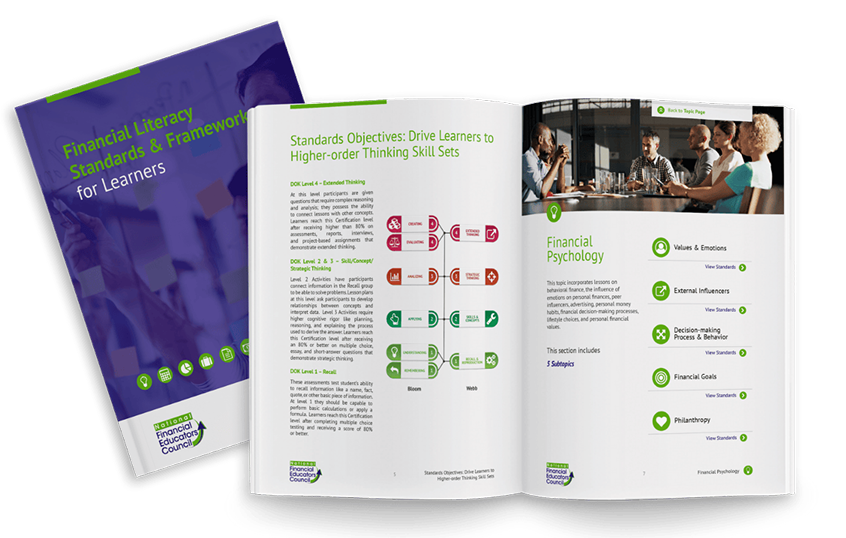
NDFEC supports the adoption of comprehensive learner outcome standards and educator competency frameworks to strengthen instructional quality statewide. By providing clear benchmarks for what students should know and be able to do – and what educators must demonstrate to teach effectively – NDFEC helps establish consistent expectations that support long-term financial capability development.

Closing Statement

North Dakota’s students deserve more than exposure to financial concepts; they deserve real preparation for the financial decisions that shape adulthood. These findings reveal a clear opportunity to strengthen financial education by aligning it with the rigor and accountability applied to other core subjects.

By advancing standards-based reform and investing in quality implementation, North Dakota can ensure that every student graduates financially prepared for life beyond high school. Meaningful progress requires collective action from educators, families, policymakers, and community leaders – working together to make financial education a foundational part of a future-ready education system.

National Financial Educators Council

North Dakota Choice Ready Graduation Requirements

North Dakota Century Code – High School Graduation Requirements (incl. Problems of Democracy or Economics with Financial Literacy)

House Bill 1533 (2025) — Financial Literacy and Concepts of Personal Finance Curriculum

North Dakota Graduation Choice-Ready Requirements (DPI)

State chapters

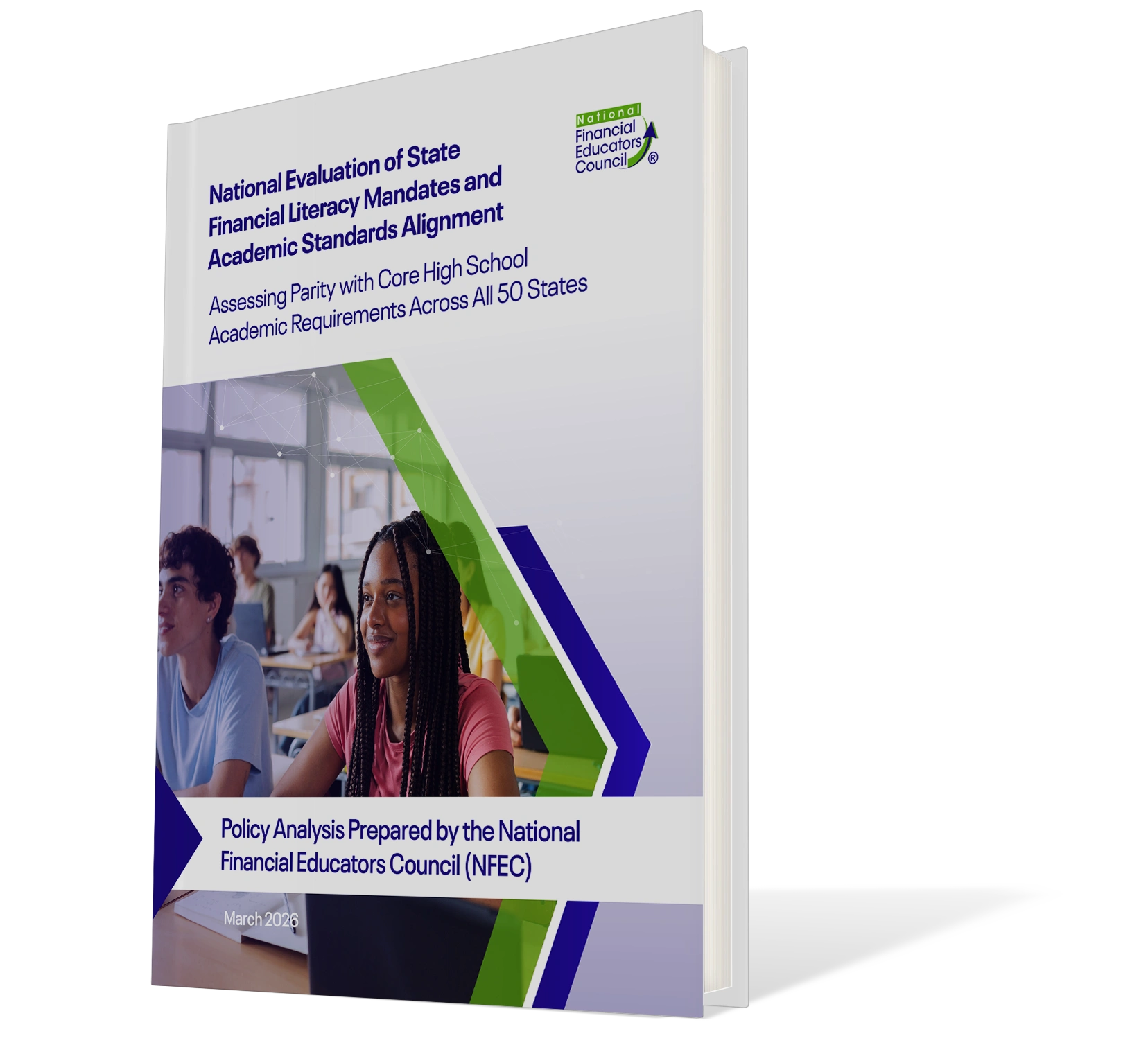
National Evaluation of State Financial Literacy Mandates and Academic Standards Alignment

State-Mandated Financial Literacy Standards: A Comprehensive National Review

Personal finance standards

Financial education services training

Teaching finance in high school

Financial Literacy Standards in North Dakota

As of 2026, North Dakota does not yet require a standalone personal finance or financial literacy course as a uniform statewide graduation requirement. Instead, North Dakota’s current high school graduation requirements include financial literacy concepts delivered either through a Problems of Democracy course or an Economics course, and the decision about which course students take is left to the local school district. Source.

North Dakota law mandates that every public high school must provide instruction in financial literacy as part of the standard curriculum, and personal finance concepts are integrated into social studies/economics content rather than a separate course. Source.

In 2025 the Legislature passed House Bill 1533 amending state code to clarify that students must complete at least a half-unit of financial literacy instruction, or that personal finance be integrated into approved courses such as economics or problems of democracy. The bill’s effective requirements began after April 24, 2025 and allow districts to satisfy financial literacy graduation requirements in multiple ways, not strictly via a separate credit. Source.

Ratings from Other Agencies

The Champlain College Center for Financial Literacy awarded North Dakota the grade of “B” in the area of financial education standards. Champlain’s research indicates that the Peace Garden State requires students to pass a course in personal finance in order to receive a high school diploma. Students may fulfill these criteria either by taking a full-year course in problems of democracy, or a half-year course in government plus a half-year course in economics.

Champlain could not estimate how many hours of personal finance instruction to which students were exposed, however, because curriculum standards for these courses did not appear on the Academic Content Standards list maintained by the North Dakota Department of Public Instruction.

The Council for Economic Education (CEE) states that North Dakota contains financial instruction in its K-12 standards mandated to be implemented by districts. A high school course is required to be offered and taken, but no testing standards exist.